
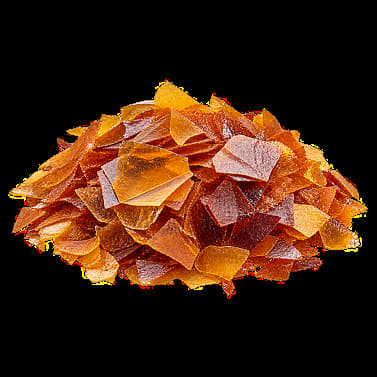
In brief: What is shellac?
Shellac is purified resin obtained from the secretion of the lac insect, identified in EU documents as Laccifer or Tachardia lacca. For use as food additive E904, the raw material is cleaned, decoloured or bleached and separated from wax.
E904 is used as a glazing agent. Its film can create a glossy surface, protect food from moisture or, on tablets, influence when the coating breaks down.
How is shellac produced?
Lac insects live on host plants and deposit a resinous secretion that hardens on branches. The collected material is mechanically cleaned and then further processed. Under the EU specification updated in 2026, only wax-free material is covered for use as E904.
Depending on the process, the resin is physically decoloured or chemically bleached. EFSA assesses these production routes separately because different impurities may be relevant.
Where may E904 be used?
EU additive legislation permits E904 only for specified uses. These include glazing certain confectionery, chocolate-coated fine bakery wares, snacks, nuts and coffee beans, as well as surface treatment of specified whole fruits. It is also authorised for food supplements and, since 2026, certain foods for special medical purposes in tablet form.
Authorisation indicates where shellac may be used; it does not mean that every product in those categories contains E904. Other glazing agents or processing methods can produce a similar appearance.
How to identify shellac on packaging
On a packaged food with an ingredient list, the additive is declared using its functional class and its name or E number, for example “glazing agent: shellac” or “glazing agent: E904”. “Confectioner’s glaze” may also be used on products from some non-EU markets.
A shiny coating on loose or whole fruit is not proof of shellac. If information is not displayed with the product, only the retailer or supplier can confirm which surface treatment was used.
- Look for shellac, E904 and glazing agent
- Confectioner’s glaze may appear on some imported products
- Gloss alone does not prove that shellac was used
Is shellac vegan?
Shellac comes from an insect secretion and is generally not considered vegan. Its status in vegetarian diets may differ by personal definition and certification standard. The ingredient list and, where relevant, a recognised certification mark are the most reliable guides.
Do not confuse E901, E903 and E904
Several additives can create a similar glossy surface. E901 is beeswax and is also animal-derived. E903 is carnauba wax from the leaves of the carnauba palm and is plant-derived. Appearance alone therefore cannot identify the substance used.
How does EFSA assess its safety?
In 2024, EFSA derived an acceptable daily intake of 4 milligrams per kilogram of body weight for wax-free shellac produced by physical decolouring. The same value is temporary for chemically bleached, wax-free shellac until additional data on possible organochlorine impurities are available.
High-end exposure estimates slightly exceeded that value in some age groups. EFSA did not consider this a safety concern because the estimates and toxicological assessment were conservative and the exceedance was small. The EU specification amended in 2026 removed wax-containing shellac because industry data indicated it was not used as a food additive and its safety could not be confirmed.
For E904’s place alongside edible insects and other insect-derived additives, read our guide to insects in food in the EU.
In short
E904 is wax-free shellac derived from the resinous secretion of lac insects. It is used as a glazing agent in specified applications and is generally not considered vegan. On packaged food, shellac and E904 are the key terms; a glossy appearance alone is not enough to identify it.
This article is for general information and does not constitute medical advice.