What does EU authorisation mean?
Insects not consumed to a significant degree in the EU before 15 May 1997 are generally novel foods. They may be marketed only after a safety assessment and inclusion in the Union list established under Regulation (EU) 2015/2283.
Authorisation is not blanket permission for every possible use. Each legal act defines the species and life stage, processing method, permitted food categories, maximum levels and labelling. Some scientific data are protected for a limited period, during which only the named applicant may market that specific novel food unless another authorisation is obtained.
The four authorised insect species
The current Union list and the European Commission overview identify four species. Separate legal acts may cover different preparations of the same species.
- Yellow mealworm – Tenebrio molitor larvae: dried whole larvae; frozen, dried and powdered forms; and UVB-treated powder made from whole, heat-treated larvae.
- Migratory locust – Locusta migratoria adults: frozen, dried and powdered forms. Legs and wings are removed from frozen and dried whole insects; the powder is subject to separate processing specifications.
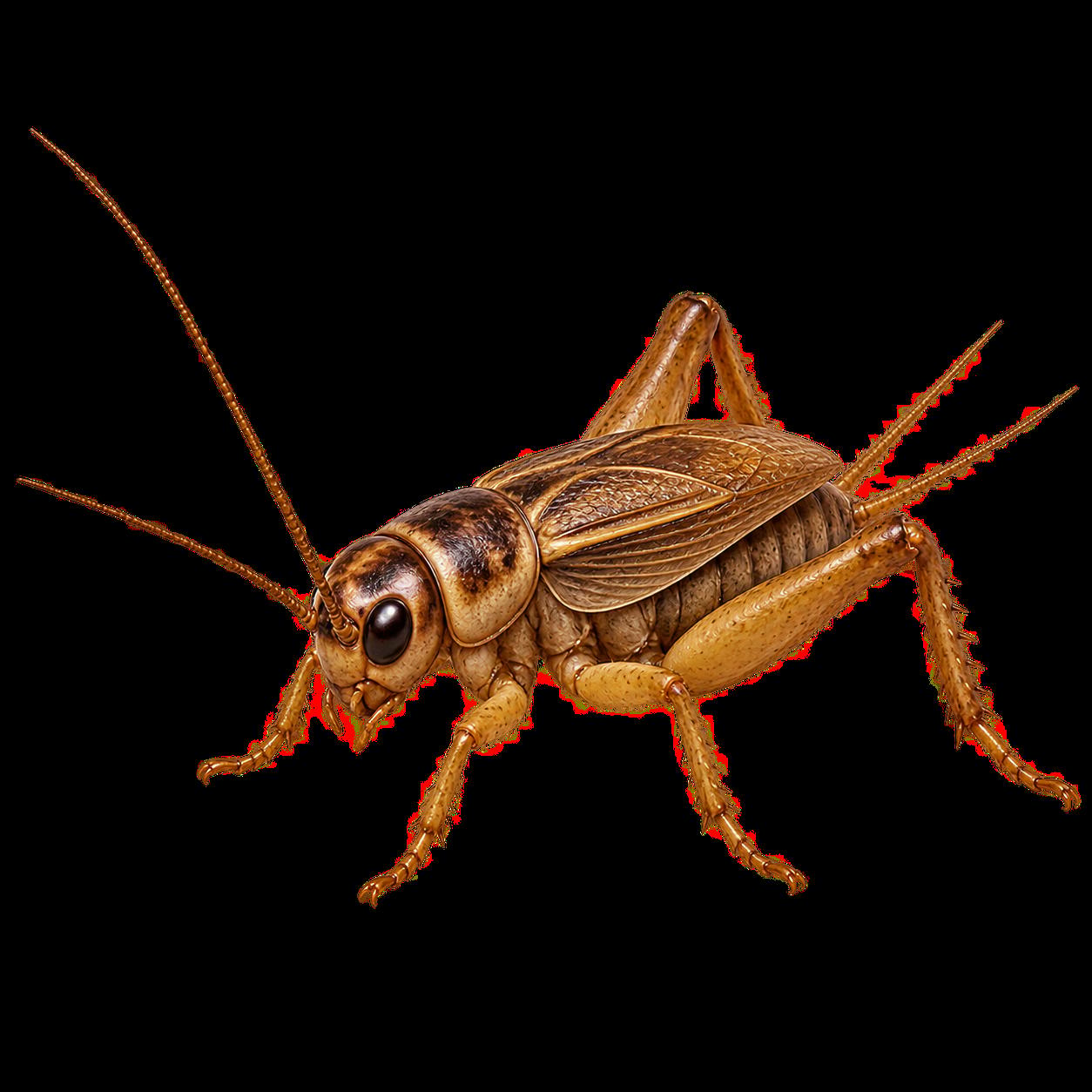
- House cricket – Acheta domesticus adults: frozen, dried and powdered forms, plus a separately authorised partially defatted powder made from whole house crickets.
- Lesser mealworm – Alphitobius diaperinus larvae: frozen, paste, dried and powdered forms made from the whole larvae.
Which foods may contain them?
Permitted uses differ between authorisations. Depending on the species and form, examples include bread and rolls, pasta, soups, snacks, meat preparations or analogues, chocolate products and certain food supplements. Each category has its own maximum level.
An authorised species therefore cannot be added to every food without restriction or without labelling. The specific entry in the consolidated Union list is always decisive.
Labelling and allergy risk
Foods must identify the novel food in the ingredient list using the designation required by the relevant authorisation. The authorisations also require warnings that allergic reactions may occur in people with known allergies to crustaceans and dust mites; some species-specific warnings also refer to molluscs.
EFSA also notes that allergens from insect feed, such as gluten, may remain in the insect product. People with relevant allergies should not rely on a scanner alone: they should read the complete current label and seek medical advice when necessary.
Authorised insect-derived additives
Not every insect-derived ingredient is governed by novel-food law. Three established substances are regulated as food additives under Regulation (EC) No 1333/2008 and have specifications under Regulation (EU) No 231/2012.
- E120 – carminic acid and carmines: a red colour whose colouring principle is extracted from dried female cochineal insects of the species Dactylopius coccus.
- E901 – beeswax, white and yellow: wax from honeycombs made by Apis mellifera; yellow beeswax is melted and purified, while white beeswax is obtained by bleaching the yellow form.
- E904 – shellac: purified and bleached resinous secretion of the lac insect Laccifer or Tachardia lacca; under the EU specification updated in 2026, the wax is removed by filtration.
What belongs to a different category?
Honey, royal jelly, propolis and bee pollen are bee products, but they are not among the four insect species authorised as novel foods. Depending on the product, they are marketed under general or specific food rules and should not be confused with a novel-food authorisation for whole insects.
Similar names can also mislead. E124 is sometimes called Cochineal Red A, but it is a synthetic azo colour and is not obtained from cochineal insects. Substances such as chitin or chitosan can come from different biological sources, so their origin cannot be inferred from the substance name alone.
How should the scientific assessment be understood?
For each novel food, EFSA assesses factors including composition, production, microbiology, toxicology, nutrition and allergenicity. A conclusion that a product is safe applies to the proposed and subsequently authorised uses and levels; it is not a general health or sustainability claim.
Protein calculated from total nitrogen may also be overestimated because insects contain chitin. Nutritional quality varies with species, life stage and processing and cannot be generalised across all insect products.
In short
Four insect species are currently authorised in precisely defined novel-food forms in the EU: Tenebrio molitor, Locusta migratoria, Acheta domesticus and Alphitobius diaperinus. The insect-derived additives E120, E901 and E904 are also permitted under additive law. Anyone wishing to recognise or avoid them should check common names, scientific names and E numbers on the current package.
This article is for general information and does not constitute medical advice.